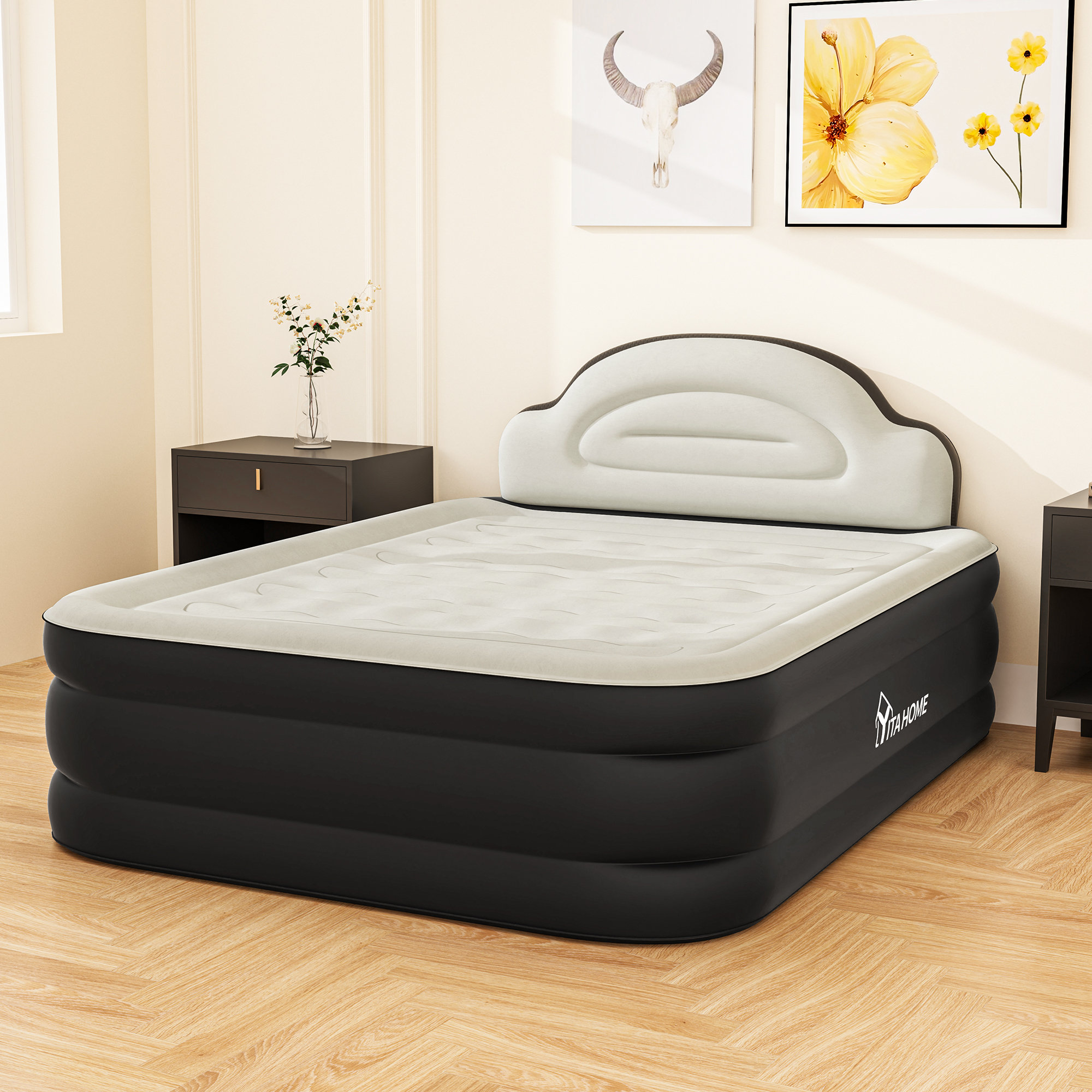
Let’s be honest for a second. Most air beds are total garbage. You wake up at 3:00 AM on a cold hardwood floor because a microscopic leak decided to ruin your life. Or worse, your pillow spent the entire night migrating off the back of the bed, leaving your neck at a 90-degree angle against the drywall. It’s a mess. But honestly, the blow up mattress with headboard has kinda changed the game for people who actually like their friends and family enough to give them a decent night’s sleep.
It sounds fancy. It’s not. It’s basically just physics and a bit of clever PVC engineering. Having that built-in backrest does two things: it keeps your pillows from pulling a vanishing act and it makes the whole setup feel like an actual piece of furniture instead of a glorified pool float.
The Problem With "Traditional" Air Beds
Most people buy the cheapest thing they can find at a big-box store. Big mistake. Huge. Standard air mattresses are essentially bouncy rectangles. They have no soul. Because there’s no structural support at the top, you can't sit up to read. You can't watch a movie comfortably. If you lean back, you’re leaning against a cold, often damp-feeling wall.
A blow up mattress with headboard fixes the "wall-lean" problem. Brands like Intex and SoundAsleep have leaned heavily into this. They realized that the psychological comfort of a headboard is just as important as the physical air pressure. When you have a dedicated headrest, the bed stays centered. It doesn't slide around as much. You feel tucked in.
What Actually Makes a Headboard Functional?
Not all headboards are created equal. Some are just flimsy extensions of the mattress that flop over if you put a pound of pressure on them. You want something with "I-Beam" construction or internal coils that extend into the headrest itself.
Look at the Intex Dura-Beam Deluxe. It’s probably the most recognizable version of this. They use these high-strength polyester fibers that don't stretch over time. That’s the secret. Most air beds fail because the PVC stretches—people think it’s a leak, but it’s actually just the material expanding. The headboard on these models is integrated, meaning it’s part of the main air chamber or has a very stable secondary one.
Then you have the height factor. A blow up mattress with headboard is almost always a "double-high" or "raised" bed. Usually 16 to 22 inches off the ground. This is crucial for anyone over the age of 25. Crawling out of a mattress that’s flat on the floor is a young person’s game. If you have your parents staying over, a raised bed with a headrest makes them feel like guests, not refugees in your living room.
Stability vs. Portability
There is a trade-off. These things are heavy. A queen-sized air bed with a full headrest can weigh 20 to 25 pounds. You aren't taking this backpacking. It’s a "closet-to-living-room" piece of gear.
The pump situation matters too. Honestly, if it doesn't have a built-in internal pump, don't buy it. Fumbling for a battery-powered external pump in the dark is a special kind of hell. Most modern headboard models feature a dial-in pump. Turn it right to inflate, left to deflate. Simple.
Why the "Pillow Slide" is a Dealbreaker
Have you ever woken up because your head hit the floor? It happens because pillows need a "stop." On a regular air bed, the gap between the mattress and the wall is a vacuum for pillows.
A blow up mattress with headboard creates a sealed environment. Your pillow stays under your head. This sounds like a minor detail until you’re the one trying to sleep. Sleep scientists, like those at the Sleep Foundation, often point out that sleep environment stability—including the position of your head and neck—is the primary driver of REM cycle consistency. You can't get deep sleep if you're subconsciously chasing a pillow all night.
Real-World Durability: The Cat Problem
Let's talk about the elephant in the room. Or the cat in the room. PVC and claws don't mix. Even the most "puncture-resistant" blow up mattress with headboard is still just a bag of air.
- Flocked tops: This is that velvety material on the surface. It’s not just for comfort. It adds a layer of protection against minor abrasions.
- Puncture kits: If the box doesn't include a patch kit, buy one. Tear-Aid Type B is the gold standard for vinyl. Don't use the cheap stickers that come in the box; they're useless.
- Inflation levels: Never fill it to 100% capacity. Air expands with body heat. If you pump it until it’s rock hard, the seams will eventually scream and quit. Aim for about 90% firmness.
The Best Models Currently on the Market
If you’re shopping right now, the landscape is surprisingly narrow for high-quality headboard versions.
Intex Ultra Plush Deluxe with Headboard: This is the baseline. It’s affordable and the headboard is surprisingly sturdy. It uses the "Fiber-Tech" construction which prevents the "trough" effect where two people roll into the middle.
Bestway Tritech Airbed: They have a version with a headrest that includes built-in LED lights sometimes. Kind of a gimmick, but the "Tritech" material (a polyester mesh core encased in two layers of PVC) is legit. It holds its shape better than standard vinyl.
Active Era Premium: Often overlooked, but they do a raised bed with a structured headrest that feels very "real bed-ish."
Maintenance You’ll Actually Do (Or Should)
When you’re done with the guest, don't just shove the bed into the bag. Moisture is the enemy. When people sleep, they sweat. That sweat gets trapped between the sheets and the flocked top. If you fold it up wet, you’re growing a mold colony.
Deflate it. Wipe it down with a dry cloth. Let it sit for an hour. Then fold it. And for the love of everything holy, don't over-fold it. Creases create weak points in the PVC. Roll it loosely if you have the space.
Setting Up for Success
Don't just throw the blow up mattress with headboard on the floor and call it a day.
Put a rug or a blanket underneath it. This prevents the "squeak" every time someone moves. Vinyl on hardwood sounds like a pod of dolphins is having a meeting in your guest room. A bottom layer also acts as insulation. Air inside the mattress takes on the temperature of the floor. If the floor is cold, the bed is a giant ice pack. A thick blanket underneath keeps the heat in.
Use real sheets. Deep-pocket fitted sheets work best. Because these mattresses are thick, standard sheets often pop off the corners. Look for "Deep Pocket" labels—usually 18 inches or more.
Is It Worth the Extra Money?
Usually, a blow up mattress with headboard costs about 20% to 30% more than the flat version. If you use it once a year for a kid’s sleepover, skip it. If you have adult guests or use it for more than two nights at a time, the headboard is mandatory. It transforms the experience from "I'm sleeping on the floor" to "I'm staying in a guest suite."
The psychological impact of a headboard shouldn't be underestimated. It makes the space feel intentional. It says you didn't just throw an emergency kit on the carpet; you set up a bed.
Practical Next Steps for the Smart Buyer
- Measure your space: These beds are bigger than they look in photos. A queen with a headboard needs a significant footprint. Ensure you have 2 feet of walking space on at least one side.
- The 24-hour stretch: When you first get your blow up mattress with headboard, inflate it immediately. Let it sit for 24 hours without anyone sleeping on it. The PVC needs to settle and stretch. You'll likely need to add more air after that first day. This isn't a leak; it's the material breaking in.
- Check the warranty: Quality brands offer at least a 1-year warranty. If it doesn't have one, it’s a disposable product. Avoid those.
- Invest in a topper: If you want to be the ultimate host, put a 1-inch foam topper over the air bed before you put the sheets on. It masks the "plastic" feel and makes it indistinguishable from a real mattress.
A good guest bed is an investment in your sanity. No one wants a cranky mother-in-law who didn't sleep because her pillow fell behind the radiator. Get the headboard. It's worth the extra fifty bucks.